Overview
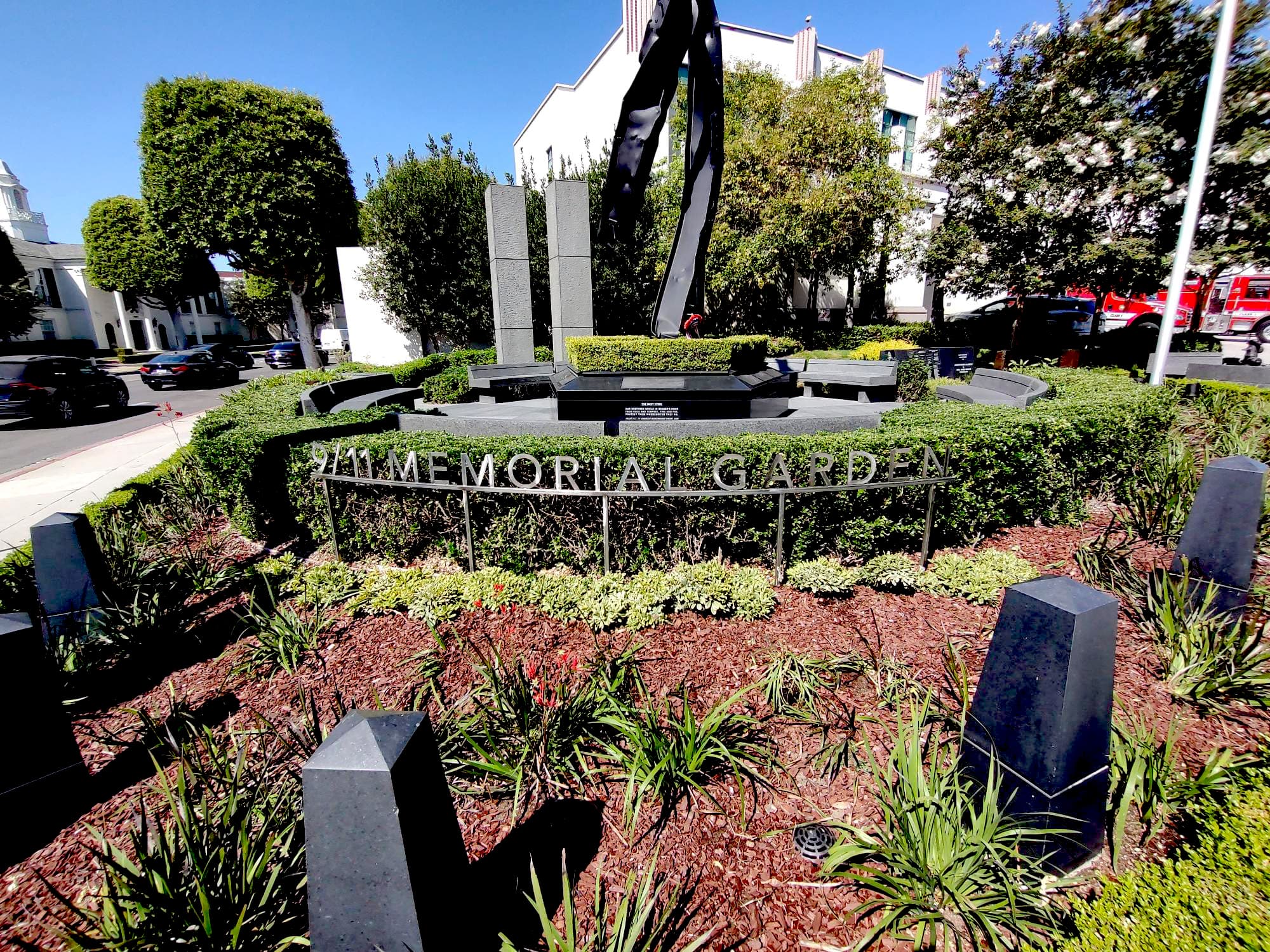
The Beverly Hills 9/11 Memorial Garden is one of the only places in Southern California where students can stand in the presence of an original artifact from the World Trade Center. Located on the grounds of the Beverly Hills Fire Department, the garden was dedicated on September 11, 2011, and is open to the public 365 days a year.
The memorial tells its story spatially and visually — through a bent steel beam salvaged from the Twin Towers, a pentagonal base honoring the Pentagon, stone replicas of the Twin Towers, and an open green space representing the field in Shanksville, Pennsylvania.
For many students today, September 11, 2001 is history — something they read about, not something they remember. A visit to this garden bridges that gap. Standing in front of a piece of the actual World Trade Center changes how students engage with the material in ways a textbook cannot replicate.
Learning Objectives
By the end of this visit experience, students will be able to:
01
Knowledge
- Describe the events of September 11, 2001, including all four crash sites and the timeline of the day
- Identify the symbolic elements of the Beverly Hills Memorial Garden and explain what each represents
- Explain the significance of the documents sealed in the memorial's foundation
- Describe how the memorial was funded and built by the community
02
Skills
- Read and analyze primary source material (inscriptions, plaques, documentary evidence)
- Practice close observation and inference using physical artifacts and designed spaces
- Articulate connections between a historical event and a designed memorial space
03
Values & Dispositions
- Demonstrate respectful, contemplative behavior in a memorial space
- Reflect on civic responsibility, community action, and the role of remembrance
- Develop empathy for those affected by tragedy and those who responded with courage
Grade Band Guidance
Use the descriptions below to calibrate depth, vocabulary, and discussion framing for your students.
Grades 4–6
Introduction & Empathy
- Focus on helpers and heroes
- What happened, simply told
- Why communities build memorials
- Guided Exploration is ideal here
Grades 7–9
Context & Connection
- Timeline and sequence of events
- Role of first responders
- Primary source analysis
- Civic identity and national response
Grades 10–12
Analysis & Reflection
- Memorialization as civic act
- Community agency and volunteerism
- Design critique and symbolism
- All discussion questions
Standards Alignment
This visit supports the following California Common Core and History-Social Science Framework standards.
| Standard | Description | Grades |
|---|---|---|
| CCSS.ELA RH.6-8.1 | Cite textual evidence to support analysis of primary and secondary sources | 6–8 |
| CCSS.ELA RH.9-10.6 | Compare the point of view of two or more authors for how they treat the same topic | 9–10 |
| CA HSS 11.11.1 | Discuss significant domestic policy issues following the September 11, 2001 attacks | 11 |
| CA HSS 8.2.7 | Describe principles of American democracy and their relationship to founding documents | 8 |
| CCSS.ELA W.6-8.1 | Write arguments to support claims with clear reasons and relevant evidence | 6–8 |
| CA HSS 5.0 | Students explain the meaning of the American creed as a set of commonly held beliefs | 5 |
Key Vocabulary
Introduce these terms before the visit. Students who arrive with this vocabulary will engage more deeply.
| Term | Definition |
|---|---|
| Artifact | An object made or used by humans that has historical significance. The steel beam here is a primary artifact from the World Trade Center. |
| Civic Responsibility | The duties and obligations that come with being a member of a community — including acts like volunteering and preserving shared history. |
| Commemoration | A ceremony or act that honors the memory of a person or event, often repeated annually. |
| First Responder | Firefighters, police officers, paramedics, and others trained to respond to emergencies. Hundreds lost their lives on September 11, 2001. |
| Memorial | A structure or place created to honor and remember people who have died or an event that caused great loss. |
| Patriotism | A love of and devotion to one's country, often expressed through pride in its history, values, and people, and a commitment to its well-being. |
| Pentagon | The headquarters of the U.S. Department of Defense near Washington, D.C., and one of the three sites attacked on September 11, 2001. |
| Symbolism | The use of an object, shape, or element to represent a bigger idea or meaning. Every part of this memorial was designed with symbolism in mind. |
| Terrorism | The use of violence or threats to intimidate people or governments, usually for political purposes. |
Before the Visit
A well-prepared class will get significantly more from the visit. Complete the following activities in the 1–2 weeks before your trip.
Activity 1 — The Timeline (45 min)
Walk students through the timeline of September 11, 2001 using age-appropriate source material. Focus on the sequence of events: the four flights, the two towers, the Pentagon, and Shanksville. Emphasize the role of first responders throughout.
Activity 2 — What Is a Memorial? (30 min)
Show students images of two or three different memorials (e.g., the Vietnam Veterans Memorial Wall, the National 9/11 Memorial pools in New York). Ask: What choices did the designers make? What does each memorial make you feel? What does it ask you to do?
Activity 3 — The Founding Documents (20 min)
The memorial's foundation contains copies of the Declaration of Independence, the Constitution, the Bill of Rights, and the Gettysburg Address. Review what each document says. Ask students: Why would the builders choose to place these inside the foundation?
Day-of Visit Structure
Suggested structure for a 75-minute visit. Adjust timing based on group size and grade level.
| Time | Structure |
|---|---|
| 0–10Arrival | Arrival & Orientation Gather at the garden entrance. Remind students of expectations for conduct in a memorial space. Give a brief 2-minute orientation: what they are about to see and why it matters. |
| 10–15First Look | Silent First Impression Ask students to walk through the garden silently for 3–5 minutes before any discussion or activity. Notice: What draws your eye first? How does the space make you feel? |
| 15–50Core Activity | Guided Exploration Distribute the Guided Exploration worksheet. Students work individually or in pairs.
|
| 50–65Discussion | Group Discussion at the Benches Gather at the curved granite benches around the beam. Lead a 10–15 minute discussion using 2–3 questions from Section 8. Face the beam during discussion if possible. |
| 65–75Close | Moment of Reflection & Departure Close with a moment of silence. Invite any student who wishes to share a final thought. Remind students of post-visit assignments. |
Discussion Questions
Organized from concrete to abstract. Use during the visit or as post-visit writing prompts.
The beam is "bent, but not broken." What does that mean to you? Can you think of a time from history or your own life when something was bent but not broken?
Grades 4–12
Every element was chosen on purpose. Which element surprised you the most, and why?
Grades 4–12
The foundation contains the Declaration of Independence and the Constitution. Why include these? What were the builders saying about what was attacked on September 11?
Grades 6–12
This memorial was paid for entirely by private donors. What does that tell us about civic responsibility? Why might it matter that no government money was used?
Grades 7–12
The memorial sits on Beverly Hills Fire Department grounds. First responders pass it every day. What does that mean? What is the significance of this location?
Grades 7–12
Memorials make choices about what to include and leave out. What is NOT in this garden? What would you add or change? What does every memorial leave unsaid?
Grades 9–12
In 50 years, most people alive today who remember September 11 will be gone. What is your generation's responsibility in keeping that memory alive?
Grades 10–12
After the Visit
Writing Assignment — All Grades
Grades 4–6: Ask students to write 1–2 pages within one week of the visit.
Draw and describe your favorite element of the garden. Why was it important to the designers? Why was it important to you?
Grades 7–9:
Choose one symbolic element and write an essay explaining what it represents, how it connects to September 11, and what it teaches visitors.
Grades 10–12:
Write an analytical essay: "What does the Beverly Hills 9/11 Memorial Garden argue about what it means to be an American?" Use specific garden elements as evidence.
Class Activity — Letter to a Future Visitor
Ask each student to write a short letter to a student who will visit the garden ten years from now. What do they want that future student to know, feel, or understand? Consider submitting the best letters to the Memorial Committee for the Memories & Reflections section of the website.
Optional Assessment — Memorial Design Project
Ask students to design their own memorial for an event or person of their choosing. They must present: what they would put at the center, what each element symbolizes, and why their choices matter.
Extensions & Projects
Oral History Project
Ask students to interview a family member or community member who was an adult on September 11, 2001. What do they remember? Where were they? How did it change them? Compile into a class oral history document.
Comparative Memorial Study
Compare the Beverly Hills garden to the National 9/11 Memorial in New York (virtual tour at 911memorial.org). How are they different? What choices did each designer make? Which approach do students find more powerful, and why?
Civic Action — Support the Memorial
Students research how the Beverly Hills 9/11 Memorial Garden is sustained through the Beverly Hills Fire Chiefs Fund and private donations. Consider organizing a small class fundraiser or awareness campaign — connecting the lesson of civic volunteerism directly to action.
Handling Sensitive Content
Some students may have personal connections to September 11. Before the visit, consider privately asking students and/or parents if there are sensitivities you should know about. Approach those students with particular care.
Age-Appropriate Framing
For younger students (grades 4–6), frame the story around the helpers and community response. Emphasize courage, care, and community action over the violence of the attacks. The garden itself does this — it honors and remembers rather than depicting graphic imagery.
For older students, engage more directly with historical facts, geopolitical context, and the complexity of the national response — including difficult questions about civil liberties, foreign policy, and justice.
If a Student Becomes Upset
Have a quiet plan in place. Designate a support chaperone who can step aside with a student who needs a moment. Validate feelings without dwelling. Give students the option to write rather than speak if verbal discussion is difficult.
Use "the people who were killed" rather than "the people who died" — this acknowledges the intentional nature of the attacks without graphic detail. Use "the attackers" or "the terrorists" rather than naming the group, particularly with younger students.
Logistics & Planning
Pre-Visit Checklist
- Contact the memorial at (310) 285-1000 to notify of your group visit date and size
- Obtain parent/guardian consent forms
- Print copies of the Guided Exploration (one per student or pair)
- Review the sensitive content section and communicate with parents if needed
- Brief chaperones on the visit structure and expectations for conduct
- Confirm transportation and arrival time
- Complete pre-visit classroom activities (Section 6)
Practical Information
- Practical Information
- 445 North Rexford Drive, Beverly Hills, CA 90210. Corner of N. Rexford Drive and S. Santa Monica Blvd.
- Hours
- Open daily, 7:30 am – 8:00 pm. Free admission. No advance registration required for general visits.
- Parking
- Street parking is available on Rexford Drive and surrounding streets. Beverly Hills Civic Center parking structure is nearby.
- Accessibility
- The garden is on ground level. Contact the memorial in advance to discuss specific accessibility needs for your group.
- Group Size
- The garden can accommodate school groups. For large groups, consider arriving in two separate waves.
- Weather
- The garden is outdoors. Have a contingency plan for rain. Morning visits are generally cooler and quieter.